How to write a good prompt
Updated 2026-11-01 · Beginner guide · 6 min read
Short answer: tell the AI who to be, your situation, what to do, the limits and what the answer should look like. That is the 5-part formula: Role, Context, Task, Constraints, Output.
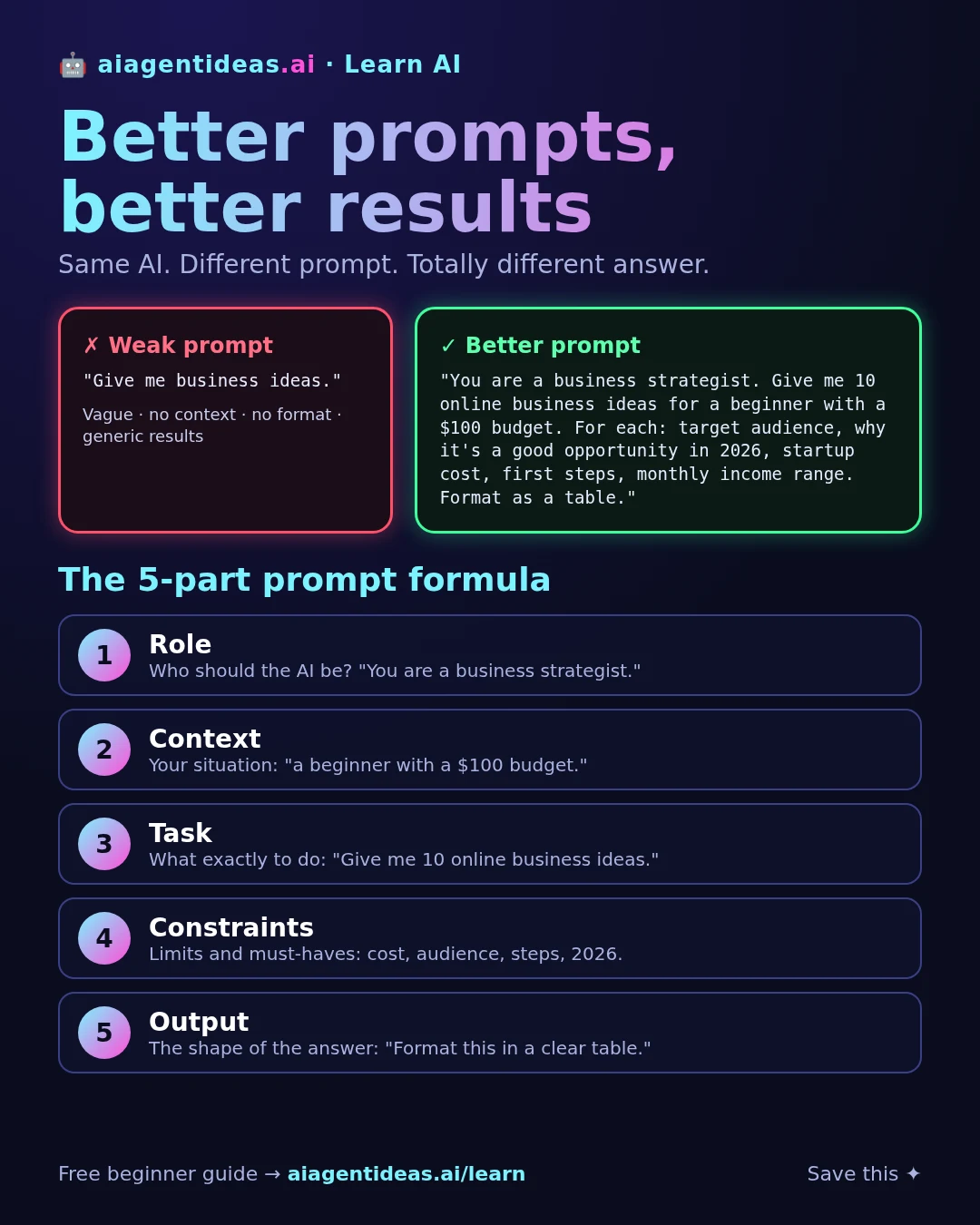
AI assistants are only as good as the instructions you give them. Two people can ask the same AI about the same topic and get completely different results. The difference is almost always the prompt. Here is one example that shows it.
A weak prompt vs a better prompt
✗ Weak prompt
Give me business ideas.
✓ Better prompt
You are a business strategist. Give me 10 online business ideas for a beginner with a $100 budget. For each idea include:
- target audience
- why it's a good opportunity in 2026
- estimated startup cost
- steps to get started
- potential monthly income range
Format this in a clear table.
Why the weak prompt fails
- It is vague. What kind of business? Online, local, a side hustle, a startup? The AI has to guess.
- There is no context. The AI does not know your budget, skills or experience, so it cannot tailor anything to you.
- There is no format. You will likely get a long block of text that is hard to compare or act on.
- The results are generic. With nothing to go on, the AI gives the most average answer: "start a blog, sell on Etsy, try dropshipping".
Why the better prompt works
- A role ("business strategist") pushes the answer toward practical, expert thinking.
- Context (a beginner with $100) rules out ideas that need big money or deep skills.
- A clear task (10 online ideas) tells it exactly how much to give you.
- Constraints (audience, why in 2026, cost, steps, income range) make every idea complete and comparable.
- An output format (a table) makes the answer easy to scan and pick from.
One thing to remember: income ranges and "opportunity" claims from an AI are guesses, not facts. Use them as a starting point and check them yourself.
The 5-part prompt formula
Role: Tell the AI who to be.
Example: "You are a business strategist."
A role sets the expertise, vocabulary and point of view of the answer.
Context: Explain your situation.
Example: "I am a beginner with a $100 budget."
Context is what the AI cannot guess: who you are, what you have, what you already tried.
Task: Say exactly what you want done.
Example: "Give me 10 online business ideas."
Use a clear action verb (give, write, explain, compare) and a number if you can.
Constraints: Add limits and must-haves.
Example: "For each idea include target audience, startup cost and first steps. Focus on 2026."
Constraints stop the AI from wandering and make the answer fit your real life.
Output: Describe the shape of the answer.
Example: "Format this in a clear table."
Table, bullet list, short email, 100 words, step-by-step: say it and you get it.
A handy template you can copy:
You are a [ROLE].
[CONTEXT: who I am, my situation, what I have].
[TASK: what you want, with a number if possible].
[CONSTRAINTS: must include / must avoid / length / level].
[OUTPUT: table, bullet list, steps, short email...].
Ready-to-use example prompts
Copy one, change the details in it to match your life, and paste it into any AI assistant.
Study help
You are a patient maths tutor. I am 15 and I struggle with fractions. Explain how to add fractions with different denominators in 5 short steps, then give me 3 practice questions with answers hidden at the end. Use simple words.
Writing an email
You are a friendly professional writer. I need to ask my manager for Friday off for a family event. Write a short, polite email under 100 words. Give me 2 versions: one formal, one casual.
Learning a new skill
You are an experienced coach for beginners. I want to learn basic video editing on my phone, with 20 minutes a day and no budget. Make a 7-day plan. For each day give the goal, what to practise and one free app or resource. Format as a table.
Planning a trip
You are a budget travel planner. Two students, 3 days in Rome in spring, total budget of 300 euros each excluding flights. Suggest a day-by-day plan with cheap food tips and free sights. Use a bullet list per day.
Social media post
You are a social media manager. I run a small online shop selling handmade candles. Write 5 Instagram captions for autumn, each under 40 words, with a call to action and 3 relevant hashtags.
Quick tips
- Refine, don't restart. If the answer is close, reply with what to change.
- Ask it to ask you. Add "Ask me 3 questions before you answer" when you are not sure what context to give.
- Give an example. Paste a sample of the style or format you like.
- Check facts that matter. AI can sound confident and still be wrong, especially on money, health and law.
- Keep private details out. Never paste passwords, ID numbers or bank details.
Not sure which assistant to use? Read the best AI chatbot for beginners or try Which AI should I use?. Then practise with a step-by-step use case.
FAQ
What is a prompt?
A prompt is the message you type to an AI assistant such as ChatGPT, Claude, Gemini or Grok. It is your instructions. The clearer the instructions, the better the answer.
What is the best prompt formula for beginners?
Use five parts: Role (who the AI should be), Context (your situation), Task (what to do), Constraints (limits and must-haves) and Output (the format you want).
Do I need all five parts every time?
No. For a quick question one line is fine. Use the full formula when the answer matters or when your first try gave you something generic.
What if the answer is still not good?
Reply and refine. Tell the AI what to change: "Make it shorter", "Use simpler words", "Focus on ideas that need no website". A prompt is the start of a conversation, not a one-shot.